Introduction
In fluid mechanics, the study of inviscid flow through a pipe is crucial for understanding the behavior of fluids in conduits. This module explores the concepts of laminar and turbulent flow in inviscid conditions, providing a foundation for comprehending fluid dynamics within pipelines.
Inviscid Flow in Pipes
- Inviscid Flow Assumption:
Inviscid flow implies neglecting viscosity in the fluid. This simplification is applicable when studying flows with very low viscosity, a common assumption in pipe flow analysis.
- Conservation of Energy:
[ \frac{1}{2}v^2 + gz + \frac{p}{\rho} = \text{constant} ]
The conservation of energy equation illustrates the balance between kinetic energy, potential energy, and pressure energy within the inviscid fluid flow.
Laminar Flow
- Hagen–Poiseuille Equation:
[ Q = \frac{\pi r^4}{8 \mu L} (P_1 – P_2) ]
Describes laminar flow through a pipe, where (Q) is the volumetric flow rate, (r) is the radius, (\mu) is viscosity, (L) is length, and (P_1 – P_2) is the pressure difference.
- Velocity Profile in Laminar Flow:
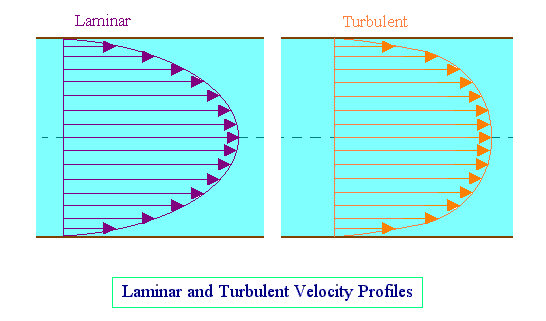
In laminar flow, the velocity profile is parabolic and follows Poiseuille’s law. The maximum velocity occurs at the centerline, and the velocity decreases linearly to zero at the pipe’s walls.
- Pressure Drop in Laminar Flow:
The pressure drop in laminar flow is directly proportional to the length of the pipe and the viscosity of the fluid. It is inversely proportional to the fourth power of the pipe radius.
Turbulent Flow
- Reynolds Number:
[ Re = \frac{\rho v D}{\mu} ]
Reynolds number is crucial in determining the transition from laminar to turbulent flow. (D) is the pipe diameter.
- Velocity Profile in Turbulent Flow:
Turbulent flow exhibits a flatter velocity profile compared to laminar flow. Velocity fluctuations occur across the pipe cross-section, and the maximum velocity is not at the pipe center.
- Pressure Drop in Turbulent Flow:
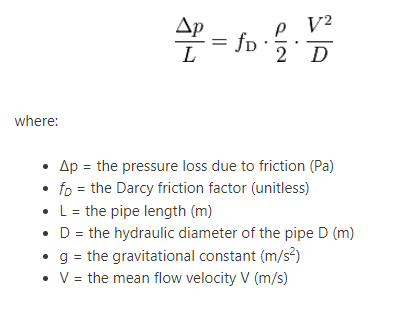
Turbulent flows result in higher pressure drops compared to laminar flows. Empirical correlations, such as the Darcy-Weisbach equation, are commonly used to estimate pressure drops in turbulent pipe flow.
Conclusion
Understanding inviscid flow through a pipe, encompassing laminar and turbulent regimes, is vital in various engineering applications. These modules lays the groundwork for further exploration into more complex fluid dynamics scenarios, including detailed analyses of velocity profiles and pressure drops in both laminar and turbulent flows.