Overview
This chapter delves into one of the fundamental topics in aerodynamics: the analysis of airflow around a two-dimensional cylinder. Specifically, it examines the characteristics of flow around a circular cylinder, whether it is stationary or spinning. The focus lies on understanding how the coefficient of drag for a stationary cylinder and the coefficient of lift for a spinning cylinder vary with changes in Reynolds number.
Two distinct flow scenarios were chosen:
- Flow over a stationary cylinder
- Flow over a spinning cylinder
CAD models of these cylinders were crafted using SolidWorks, followed by simulations performed via SimScale.
To ensure the accuracy of simulation results, extensive comparisons were made with theoretical calculations using traditional formulas for computing the co-efficient of drag and lift for stationary and spinning cylinders, respectively. Additionally, internal consistency checks were conducted by comparing results from different simulation runs, thereby enhancing confidence in the outcomes obtained.
In summary, this chapter provides valuable insights into the aerodynamic behavior of circular cylinders, whether stationary or spinning, under various flow conditions.
Flow over a Stationary Cylinder
Impact of Reynolds Number
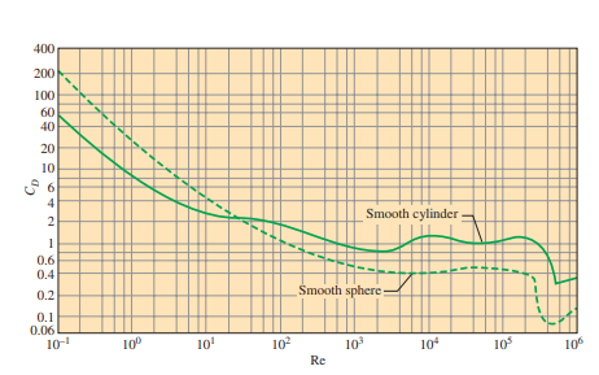
Coefficient of Drag vs Reynolds Number[23]
The flow behavior and drag experienced by a cylinder are contingent upon the Reynolds number Re = U∞D/n, where D represents the cylinder diameter, U∞ signifies the undisturbed free-stream velocity and n the kinematic viscosity. This dimensionless number delineates the ratio of inertial to viscous forces within the flow. Typically, drag is quantified by the coefficient Cd = d/(½ρU∞2D), where d denotes the drag force per unit span.
At the cylinder’s leading edge, a stagnation point emerges, halting the oncoming flow and establishing pressure equal to the stagnation pressure. According to Bernoulli’s equation, the pressure coefficient Cp = (p – p∞)/(½ρU∞2) at this point equals 1. Flow acceleration around the cylinder’s forward surface causes a pressure drop on either side of the stagnation point, forming a thin boundary layer immediately adjacent to the cylinder surface. Within this boundary layer, viscosity effects are predominantly felt.
The critical Reynolds number for flow across a circular cylinder or sphere is approximately Recr ≅ 2e5. For Re ≲ 2e5, the boundary layer remains laminar; for 2e5 ≲ Re ≲ 2e6, it becomes transitional; and for Re ≳ 2e6, it transitions to fully turbulent.
At very low upstream velocities (Re ≲ 1), the fluid entirely envelops the cylinder, with the fluid arms meeting orderly on the rear side. In this regime, known as creeping flow, the drag coefficient diminishes with increasing Reynolds number, and there is no flow separation.
Around Re ≅ 10, separation begins on the rear of the body, with vortex shedding commencing near Re ≅ 90. The extent of separation enlarges with rising Reynolds numbers up to about Re ≅ 1000, where pressure drag largely contributes to drag. Despite the drag coefficient’s decrease within the range of 10 ≲ Re ≲ 1000, the drag force, being proportional to the square of velocity, may still increase due to the velocity’s rise at higher Reynolds numbers.
In this flow analysis, we confine ourselves to Reynolds numbers ranging from 10 to 40 for simplicity.
At higher velocities, the flow remains attached to the front or windward side of the cylinder. However, as it moves towards the top or bottom of the cylinder, it detaches from the surface at approximately ± 90 degrees locations, forming a separation region behind the cylinder. This detachment leads to the formation of periodic two-dimensional vortex shedding when the Reynolds number exceeds 40.
During vortex shedding, alternate vortices originate near the ± 90 degrees locations. The flow characteristics significantly influence the total drag coefficient, Cd, with both friction drag and pressure drag playing important roles.
At high Reynolds numbers (Re ≳ 5000), pressure drag becomes dominant, while at low Reynolds numbers (Re ≲ 10), friction drag predominates. At intermediate Reynolds numbers, both effects remain important. However, detailed analysis of these effects falls outside the scope of this module.
Flow around a Spinning Cylinder
Lift Generation
When a cylinder rotates about its longitudinal axis in a fluid medium, it induces a spinning, vortex-like rotational flow around it. This rotational flow interacts with the uniform free stream to create an increase in velocity on one side of the cylinder and a decrease in velocity on the other side. Consequently, pressure drops occur where the velocity increases, and vice versa, resulting in a net upward lift force generated on the cylinder towards the low-pressure side.
The lift equation states that lift per unit length (L) is directly proportional to the velocity (V ), density (ρ), and strength of the vortex (G often written in textbooks as Greek Gamma) established by rotation:
L=ρ×V×G
Determining the vortex strength requires considering the rotational speed (Vr in m/s) of the cylinder, which is a function of its radius (b in meters) and spin rate (s in radians per second):
G=2.0×π×b×Vr
Vr=2.0×π×b×s
Validation Results
NOTE: Refer to the tutorial to view the details of the simulation set-up.
Here’s a comparison of the simulation results with what’s in the literature, based on the flow simulation conditions given in the tutorials. This helps validate our findings!
Stationary Cylinder
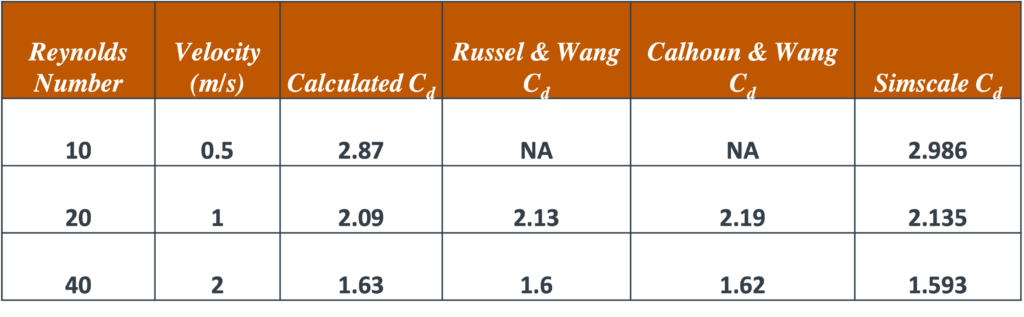
Results for Stationary Cylinder[24][25]
Spinning Cylinder
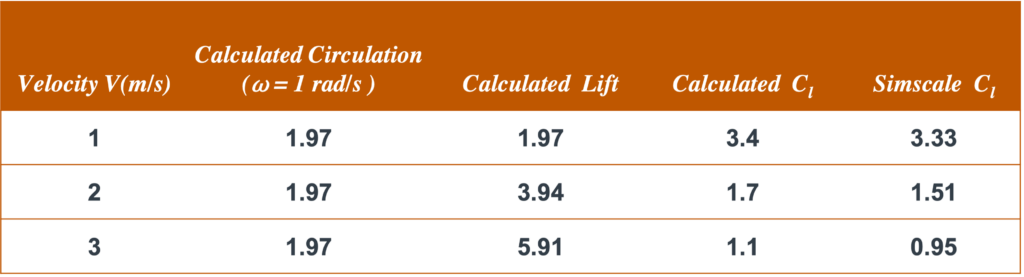
Results for Spinning Cylinder[23]
REFERENCE
[5]Anderson, J. D., 2010, “Fundamentals of Aerodynamics,” AIAA Journal, 48(12), p. 2983.
[21] Oggiano, L., Sætran, L., Løset, S., and Winther, R., 2007, “Reducing the Athlete’s Aerodynamical Resistance,” ResearchGate.
[23] Triantafyllou, G. S., Triantafyllou, M. S., and Chryssostomidis, C., 1986, “On the Formation of Vortex Streets behind Stationary Cylinders,” Journal of Fluid Mechanics, 170, pp. 461–477.
[24]Russell, D. A., and Wang, Z. J., 2003, “A Cartesian Grid Method for Modeling Multiple Moving Objects in 2D Incompressible Viscous Flow,” Journal of Computational Physics, 191(1), pp. 177–205.
[25]Calhoun, D., 2002, “A Cartesian Grid Method for Solving the Two-Dimensional Streamfunction-Vorticity Equations in Irregular Regions,” Journal of Computational Physics, 176(2), pp. 231–275.