Introduction
Flow over a cylinder is a classic fluid dynamics problem that has practical applications in various engineering fields, including aerodynamics, civil engineering, and mechanical engineering. This module will explore the aerodynamics of a cylinder under both stationary and spinning conditions.
Flow over a Stationary Cylinder
Around a stationary cylinder, the pressure distribution varies significantly. The key points include:
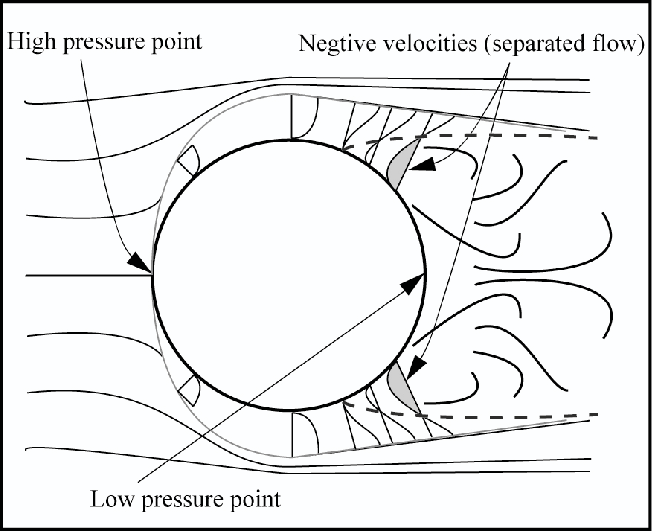
Pressure Variations around a Stationary Cylinder
As the fluid flows around the cylinder, it experiences an increase in pressure on the side facing the flow (upstream) and a decrease in pressure on the opposite side (downstream). This pressure difference is a result of the fluid decelerating as it encounters the obstacle.
Separation Point
The flow separates from the surface of the cylinder at a specific point, creating a region of low pressure behind the cylinder. This separation point is crucial in understanding the formation of vortices and the shedding of the Kármán vortex street.
Lift
- Lift on a stationary cylinder is primarily generated by the pressure difference between the upper and lower surfaces. The pressure distribution contributes to an upward force, resulting in lift.
- Lift is generally less prominent for a stationary cylinder compared to an airfoil, and its contribution is secondary to the drag force.
Drag
- The drag force arises due to the resistance the cylinder offers to the oncoming fluid. It can be divided into two components: form drag and skin friction.
- Form drag is associated with the pressure variations around the cylinder, including the wake formation and Kármán vortex shedding. Skin friction drag results from the viscous effects along the surface of the cylinder.
Flow over a Spinning Cylinder
Magnus Effect
The Magnus effect describes the lateral force exerted on a spinning cylinder in a fluid. It is a result of the different velocities experienced by the upper and lower surfaces of the cylinder.
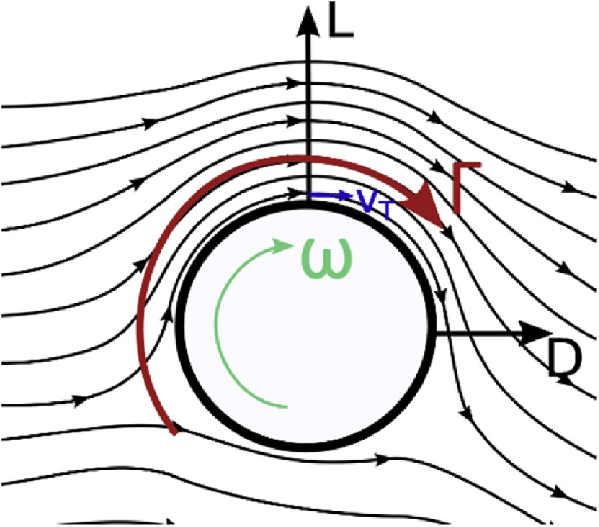
Pressure Variations around a Spinning Cylinder
When a cylinder is spinning, additional factors come into play, influencing the pressure distribution:
- The spinning motion introduces centrifugal and Coriolis forces. Centrifugal force acts radially outward, affecting the pressure distribution.
- Coriolis force, due to the rotation, can induce lateral variations in pressure. These effects contribute to the Magnus effect.
Lift
- The Magnus effect is responsible for generating lift on a spinning cylinder. The pressure difference between the upper and lower surfaces is enhanced by the rotation, leading to an increased lift force.
- The direction of the lift force is perpendicular to both the axis of rotation and the oncoming flow.
Drag
- The drag force on a spinning cylinder is influenced by the Magnus effect and the additional effects introduced by rotation.
- While the Magnus effect contributes to lift, it can also influence drag. The overall drag characteristics depend on the rotational speed, Reynolds number, and other parameters.
Conclusion
Understanding the flow over a cylinder, whether stationary or spinning, is essential for engineers and researchers in various fields. This module provides a foundation in fluid dynamics, introduces the fundamental equations, and explores the intricacies of flow patterns and forces associated with a cylindrical object. Further applications, such as sports ball dynamics, wind engineering, and vehicle aerodynamics, build upon these fundamental principles.