GEOMETRY
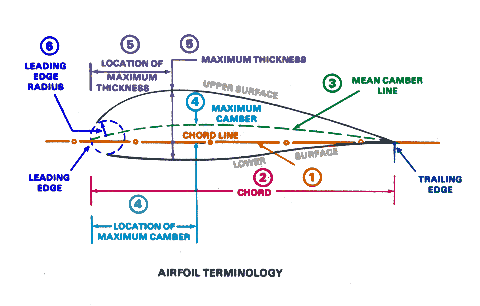
- Chord Length: Distance from leading to trailing edge.
- Camber: Curvature of upper surface (symmetric or cambered).
- Thickness Distribution: Variation along the airfoil’s surface.
- Leading Edge Radius: Curvature at the front of the airfoil.
- Trailing Edge Thickness: Thickness at the rear of the airfoil.
- Aspect Ratio: Ratio of wingspan to average chord length.
- Sweep Angle: Angle between the airfoil chord line and the direction of the airflow.
FORCES
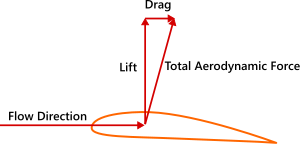
- Lift: Upward force crucial for supporting the aircraft.
- Generated by pressure difference between upper and lower surfaces.
- Drag: Resistance encountered as the airfoil moves throu
- Caused by friction, pressure differences, and form drag.
ANGLE OF ATTACK
- Angle between chord line and oncoming airflow.
- Directly influences lift and drag; critical for control.
- Varying angle of attack alters lift and drag forces.
- Increasing angle of attack initially increases lift and drag.
- Beyond a critical point, lift decreases, leading to a stall.
- Zero Lift Angle: Angle of attack where lift is zero.
PRESSURE DISTRIBUTION
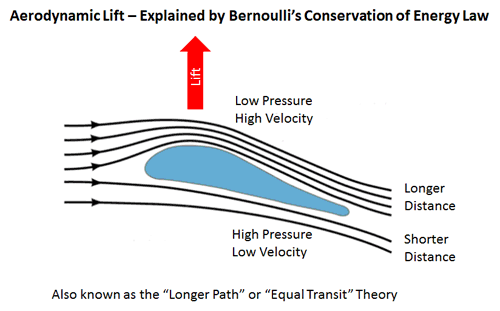
- Pressure varies across upper and lower surfaces.
- Dictates lift and drag; key to overall aerodynamic performance.
- Upper surface typically has lower pressure, contributing to lift.
- Lower surface experiences higher pressure, contributing to drag.
- Cp Distribution: Distribution of pressure coefficients on the airfoil surfaces.
CAMBER AND SYMMETRY
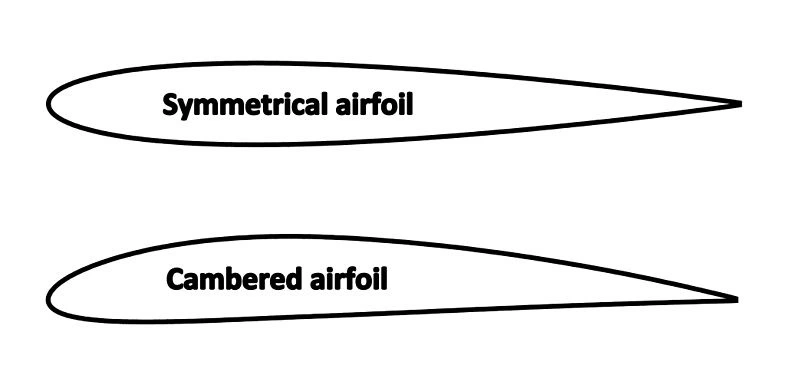
- Symmetric: Identical upper and lower surfaces.
- Cambered: Curved upper surface, generating lift even at zero angle.
- Symmetric airfoils ideal for applications requiring no lift at zero angle.
- Cambered airfoils generate lift at zero angle due to curvature.
- Mean Camber Line: Line halfway between upper and lower surfaces of a cambered airfoil.
CRITICAL ANGLE OF ATTACK AND STALL
- Critical point before stall occurs.
- Stall: Airflow separation, leading to loss of lift.
- Stall occurs when the critical angle of attack is exceeded.
- Symmetric airfoils often stall abruptly; cambered airfoils may exhibit gradual stalls.
- Post-Stall Behavior: Airfoil behavior after the onset of stall.
APPLICATIONS
- Aircraft Design: Optimize aerodynamic efficiency.
- Wind Turbine Blades: Enhance lift for energy generation.
- Automobiles: Improve fuel efficiency through reduced drag.
- Unmanned Aerial Vehicles (UAVs): Tailor airfoil for specific mission requirements.