Flow Around a Flat Plate
MODULE
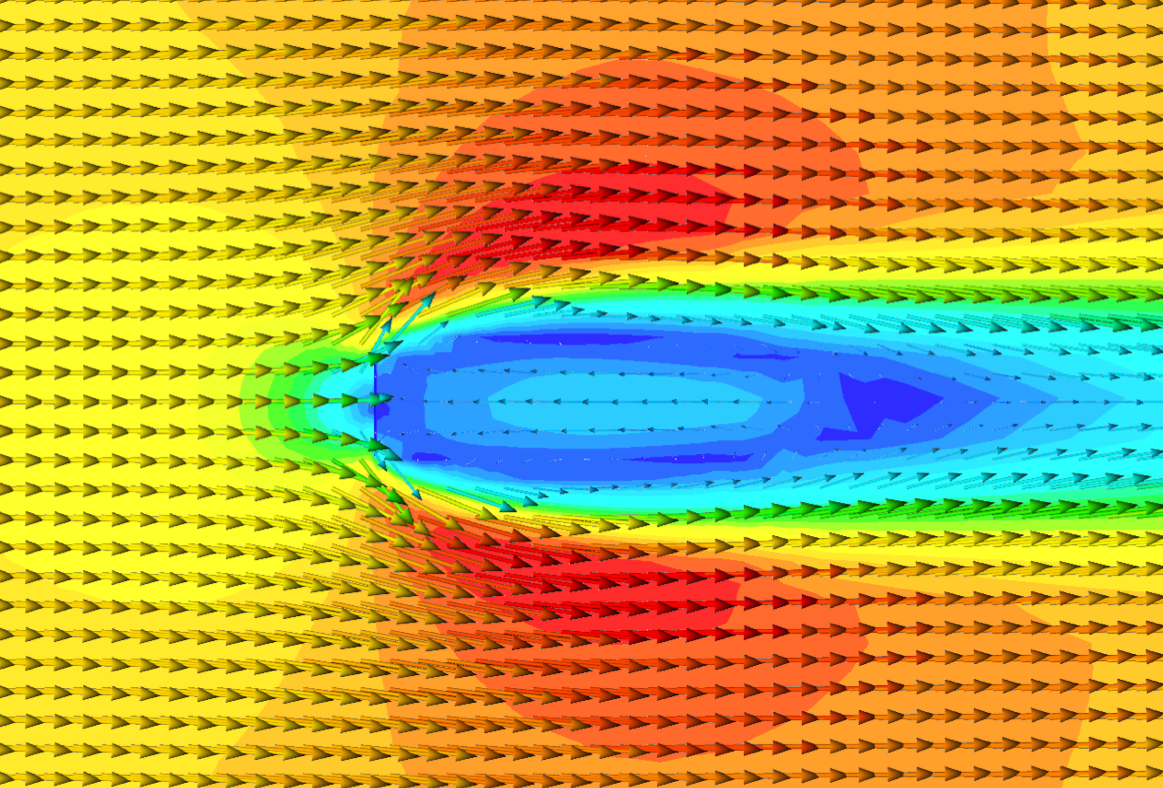
AIM
To conduct an analysis of fluid flow over a flat plate, exploring the aerodynamic characteristics by calculating drag and lift coefficients across varying angles of attack.
QUICK PEEK INTO THE TEXTBOOK
Review the TEXTBOOK to refresh your understanding of basic concepts before advancing to more complex material.
SimScale Tutorial: Flow around a Flat Plate
This tutorial aims to explore the aerodynamic characteristics of the fluid flow over a flat plate, by calculating drag and lift coefficients across varying angles of attack.
FLOW SIMULATION SETUP
Dimensions
- Length =1 m
- Span = 1m
Analysis Type
Incompressible steady-state analysis.
Turbulence Model
k-Omega SST
Fluid : Air
Flow Velocity = 80 m/s
Mesh Type
- Algorithm – Standard
- Sizing – Fine Automated
Equation Used
Coefficient of Drag(Cd) for Flat Plate (Laminar) = 1.38/sqrt(Re)
Initial Conditions
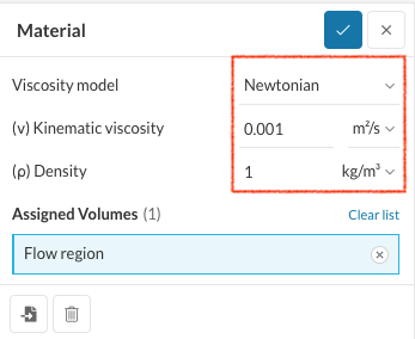
- Viscosity Model – Newtonian
- (𝜈) Kinematic viscosity = 0.001 𝑚2/s
- Density = 1 kg/m3
Let’s now delve into the SimScale process one step at a time for this particular problem.
The following tutorial is NOT designed specifically for any SPECIFIC angle of attack (AOA). For different angles of attack, please ensure the selection of the suitable CAD model and refer to the completed project for accurate values of each parameter to be entered.
Just a heads-up: The ideal way to begin is by creating a ‘New Project’ and then importing the CAD model. However, we’ve already taken care of the steps for you, including importing the CAD model. You can get started right away with the ‘Creation of Flow Domain‘ step.
Prepare the CAD Model and Select the Analysis Type
Open a ‘New Project’ & import the CAD model
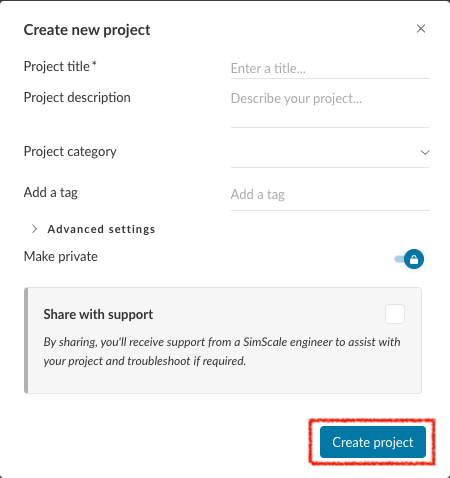
- Click open the new project, and fill the details as following dialogue box appears.
- Once details are entered, Click ‘Create Project‘.
- Click + next to GEOMETRIES, and import the CAD model
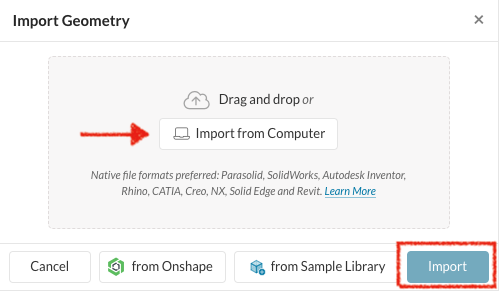
Creation of Flow Domain
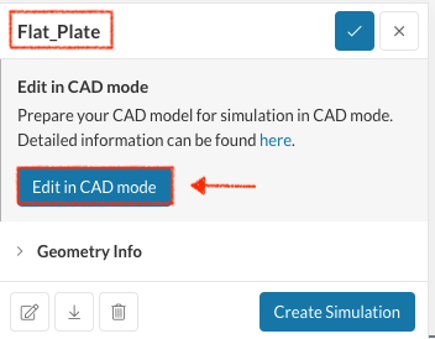
- Once imported, click the geometry, and click ‘Edit with CAD mode‘.
- In the CAD mode, select CREATE > External, and enter the following dimensions, for creating the external flow volume. It will get saved as the ‘Flow Region’.
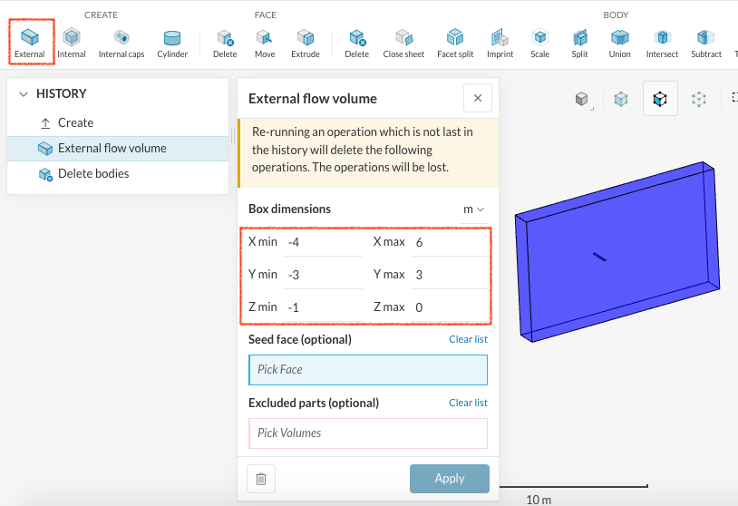
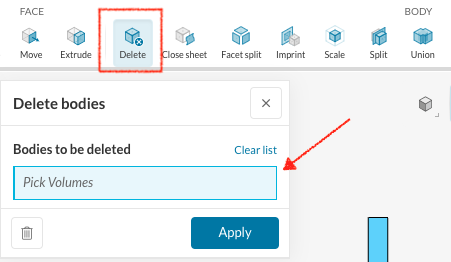
- Once the external flow volume has been created, Select DELETE from theoptions under BODY, and choose the geometry as the volume, and press APPLY.
Create Simulation
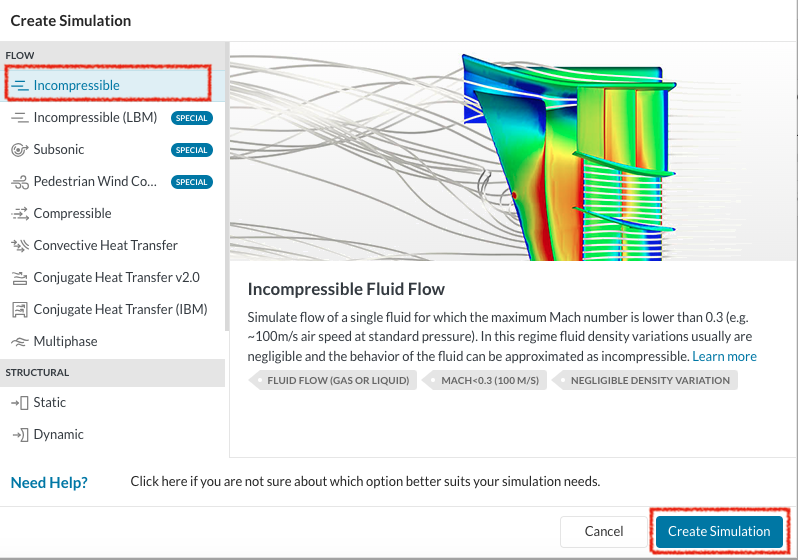
- Select ‘Incompressible’ and click Create Simulation
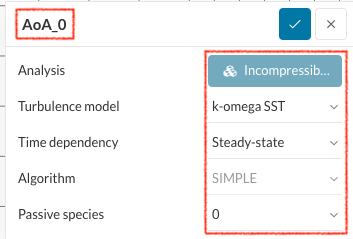
- Once the Simulation has been created, you can rename it and edit the characteristics as shown here.
- Note: Select the appropriate turbulence model based on the specific angle of attack by referring to the completed project.
Assigning the Material and Boundary Conditions
Define a Material
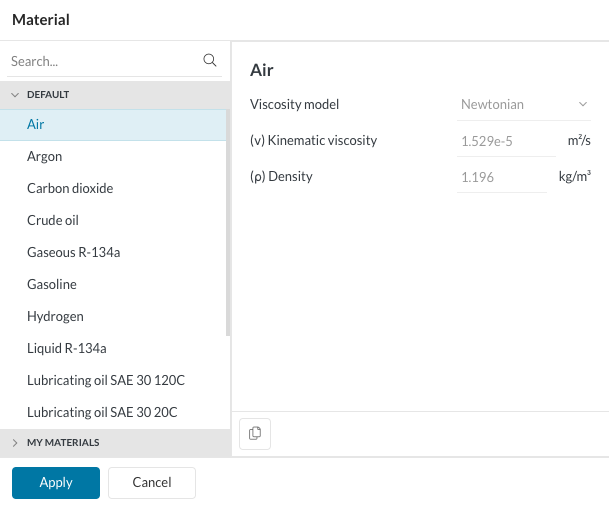
- Select any material by clicking ‘+’ next to ‘Material’, and edit its Material Name, and other characteristic features as given.
Define the Initial Conditions
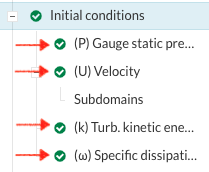
- Set the Initial Conditions, namely
- (P) Gauge static pressure = 0 Pa
- (U) Velocity(Global) = 0 m/s
- (k) Turb Kinetic Energy = 3.84e-3 m²/s²
- (w) Specific Dissipation Rate = 88.53 1/s
Define Boundary Conditions
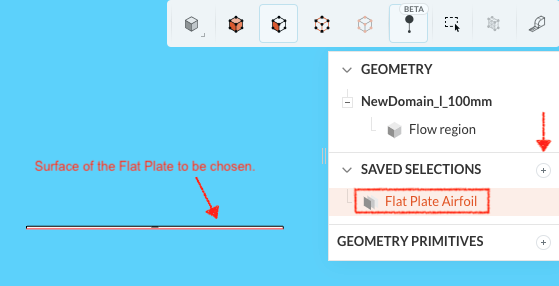
- For ease of selecting the Flat Plate Airfoil, we will add it as a SAVED SELECTION which could be selected from the dialogue box that appears on the right hand side of the workspace.
- Click +, and select all the faces of the flat plate, and press APPLY.
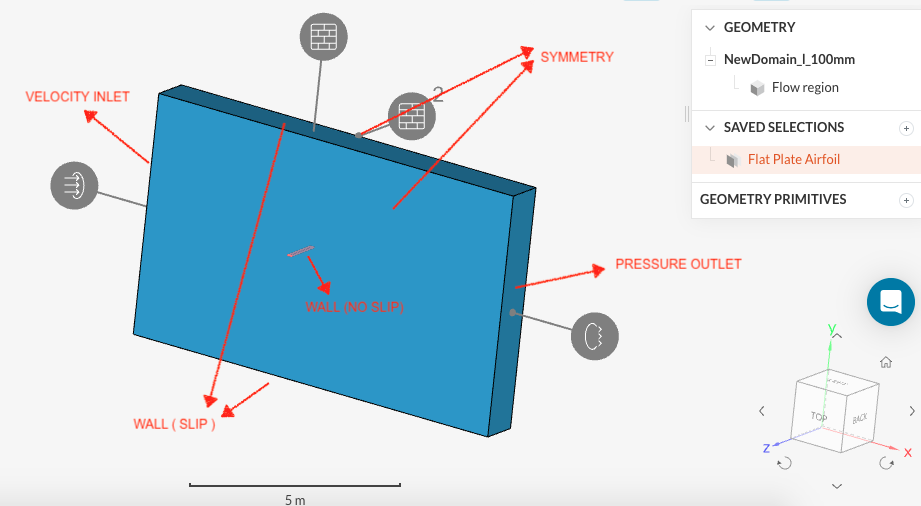
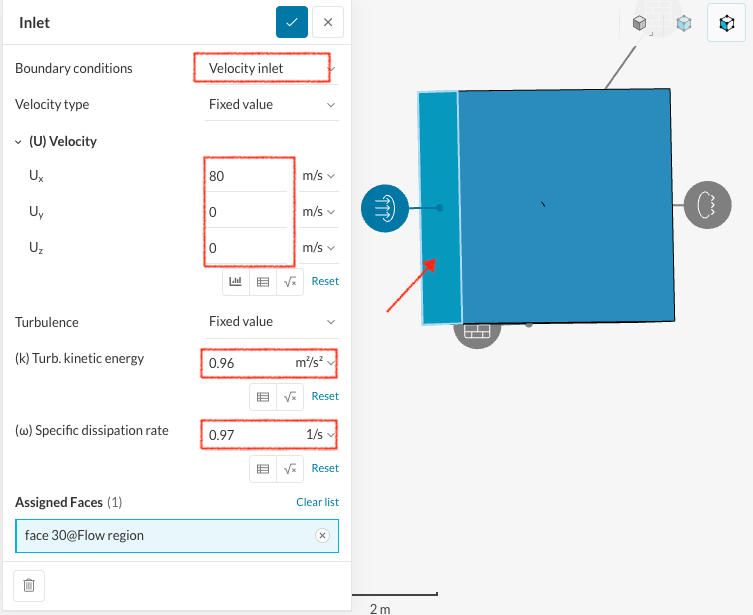
- To set up the ‘Boundary Conditions’, enter the values as given in the snippets
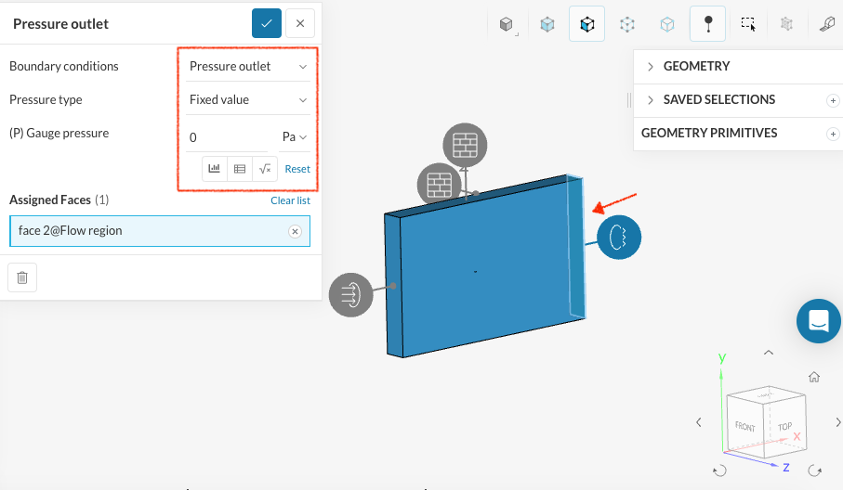
- To set the boundary condition for Outlet to be ‘Pressure Outlet’
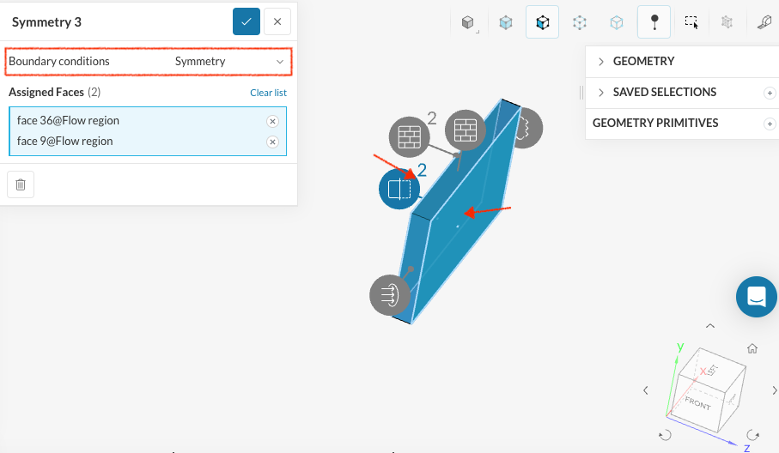
- To set a boundary condition for the the sides of the flow region, select Symmetry
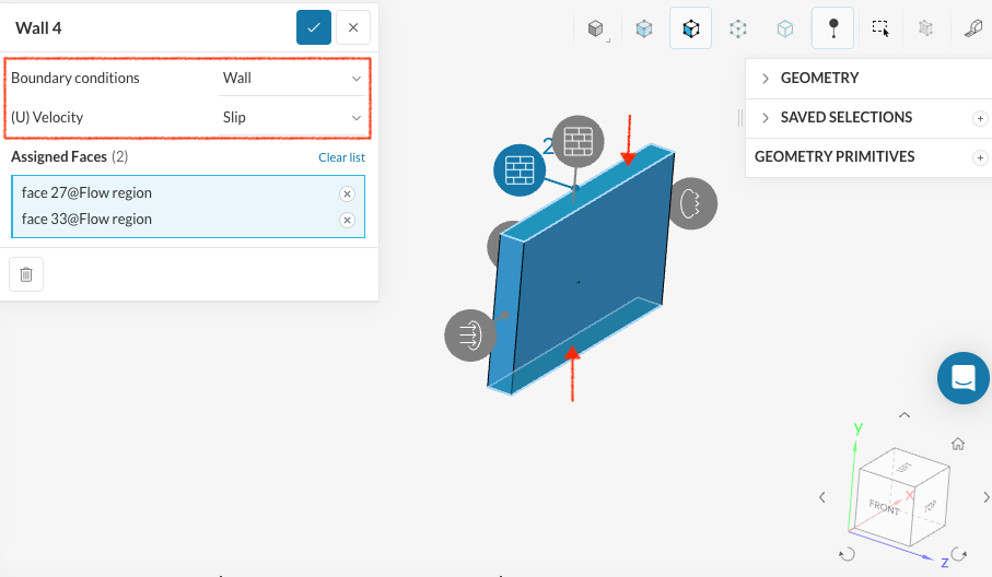
- To set the boundary condition for ‘Wall’(slip).
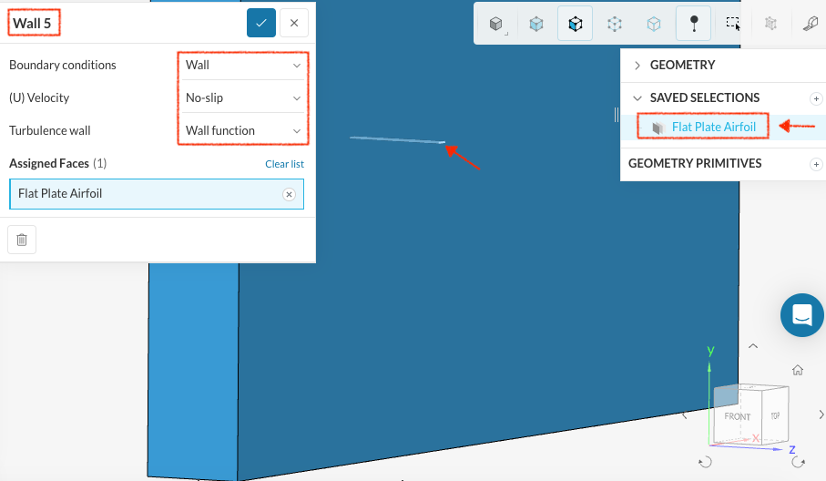
- To set the boundary condition for ‘Wall(No-Slip)’ by selecting all the faces of the airfoil.
- To set the boundary condition for Velocity Inlet.
Simulation Control
- Set the ‘Numerics’ as given in the ‘FINISHED PROJECT’.
- NOTE: In this section, there are variations in the input values for different angles of attack to achieve the most accurate results, considering the respective flow variations. Therefore, please adhere to the values provided in the final project.
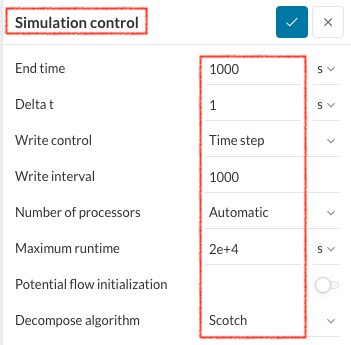
- Input the given values under the ‘Simulation Control’.
Result Control
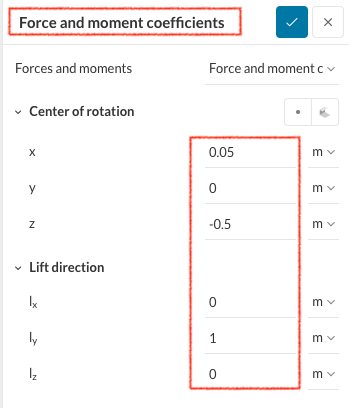
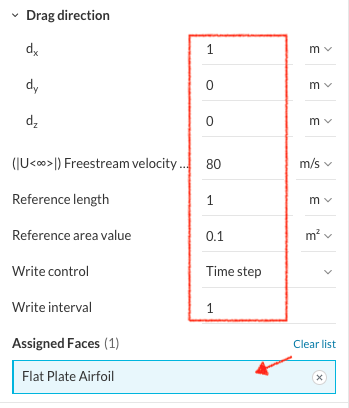
- Below ‘Result Control’, click ‘+’ next to ‘Force and Moment Coefficients’.
- Select all the faces of the airfoil.
- Now, let’s establish the ‘Force and Moment Coefficients’ by clicking on the ‘+‘ icon and entering the specified values.
- Select all the faces of the airfoil.
Mesh Generation
- Below the Mesh Settings, Click ‘+’ next to Geometry Primitives, and create the following geometry primitives, which would be used in creating the Region Refinements in the next step for meshing.
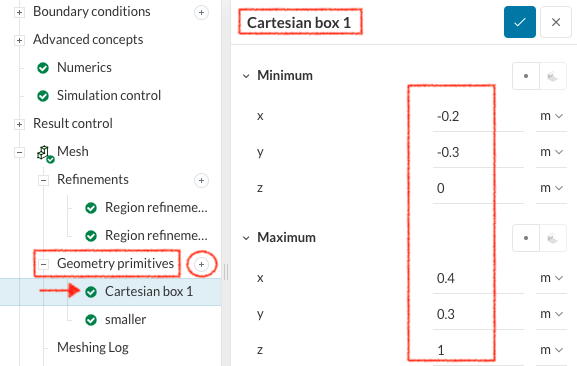
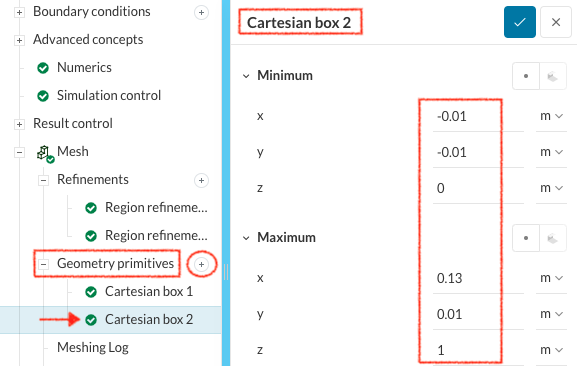
- Click on Mesh, and Click ‘+’ next to Refinement, and add the following Region Refinement for the cylinder.
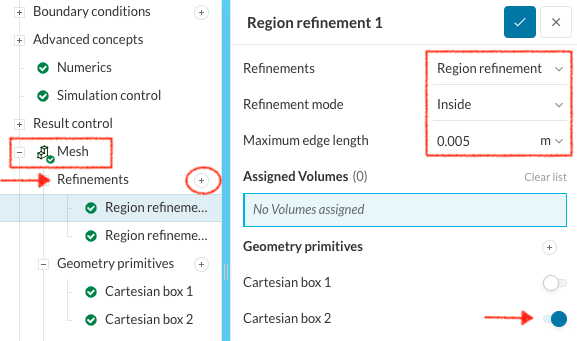
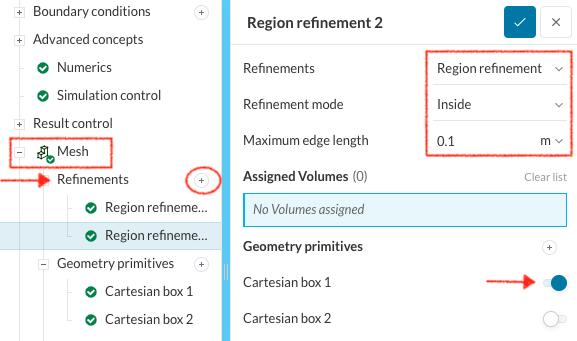
- Let’s now set up the mesh characteristics.
- Click on Mesh, and make changes to the Mesh Settings.
- Following the above, Click Generate to generate Mesh, and wait for the mesh to get generated.
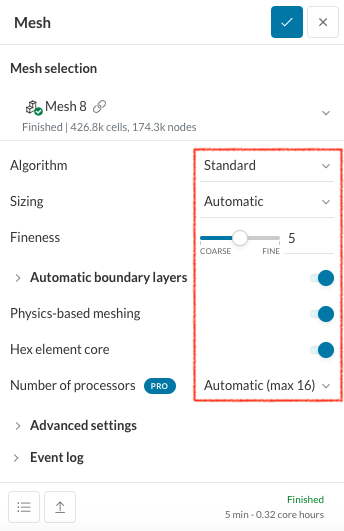
NOTE: Check the Event Log below the dialogue box once the mesh is generated to check for the mesh quality before proceeding. If the mesh is not correctly generated, Simulation Run in the next stage can get terminated prematurely.
Simulation
To initiate the simulation, follow these steps:
- Expand the ‘Simulation Runs’ section by clicking on the ‘+‘ symbol.
- Then, select the ‘Run’ option to start the simulation process, and then click ‘Start’.
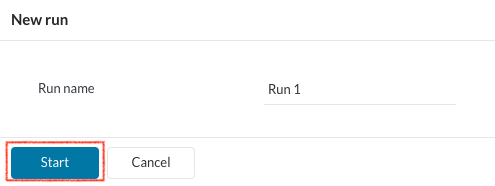
This action will prompt the software to execute the simulation based on the defined parameters and settings.
Processing
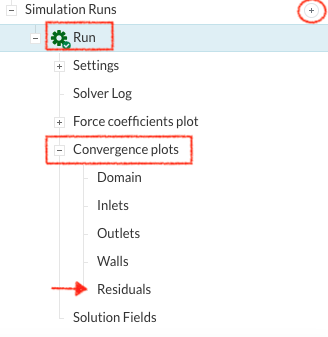
- Select the ‘Convergence plots’ below ‘Run’ to check for convergence. In an iterative method, residuals represent the disparities in the solution. Achieving numerical precision involves minimizing these residuals.
- Typically, aiming for residuals below 1e-3 is a suitable threshold to proceed to the next assessment.
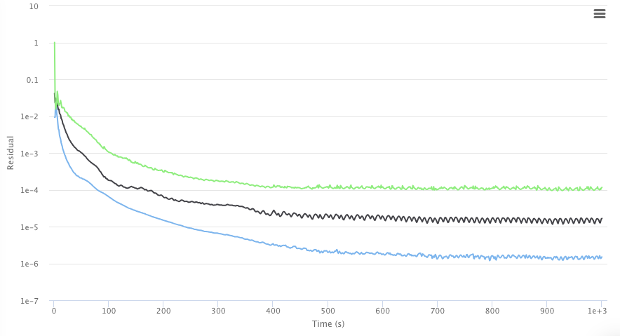
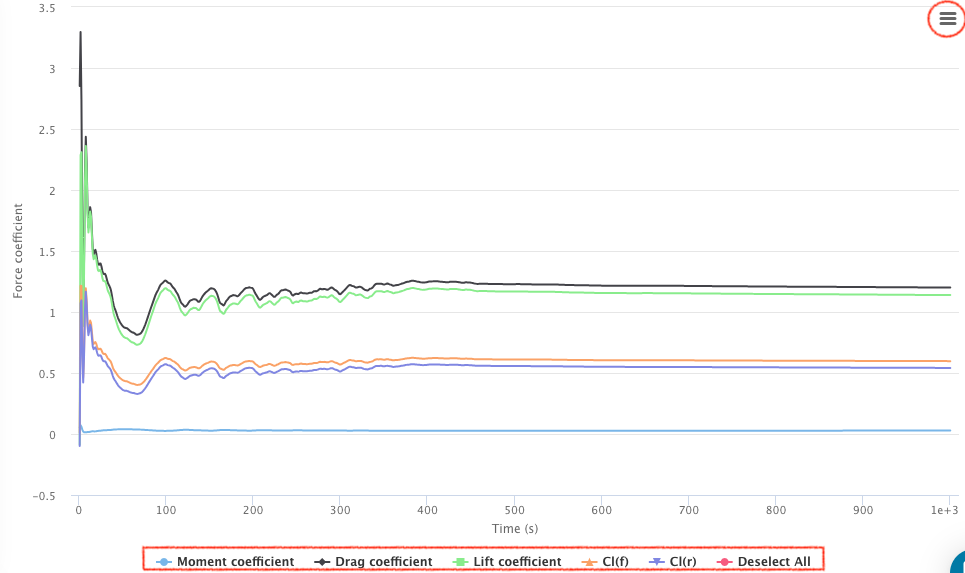
- Another aspect to consider is examining the exact values for Force coefficients, such as the coefficient of drag, lift, moment, and so forth, to ascertain their convergence.
This entails analyzing whether these coefficients have stabilized and reached consistent values over successive iterations, indicating convergence in the solution.
Post- Processing
- Once the simulation is ‘Complete‘, you can access the post-processing environment by clicking on ‘Solution Fields’ or ‘Post-process results’.
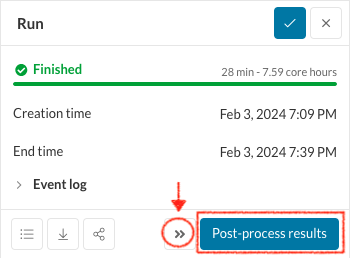
After checking the residuals, if you think it has not yet been converged, you will see the “Continue to run >>” icon, in which you can enter the end time to be your present end time and increase the maximum run time.
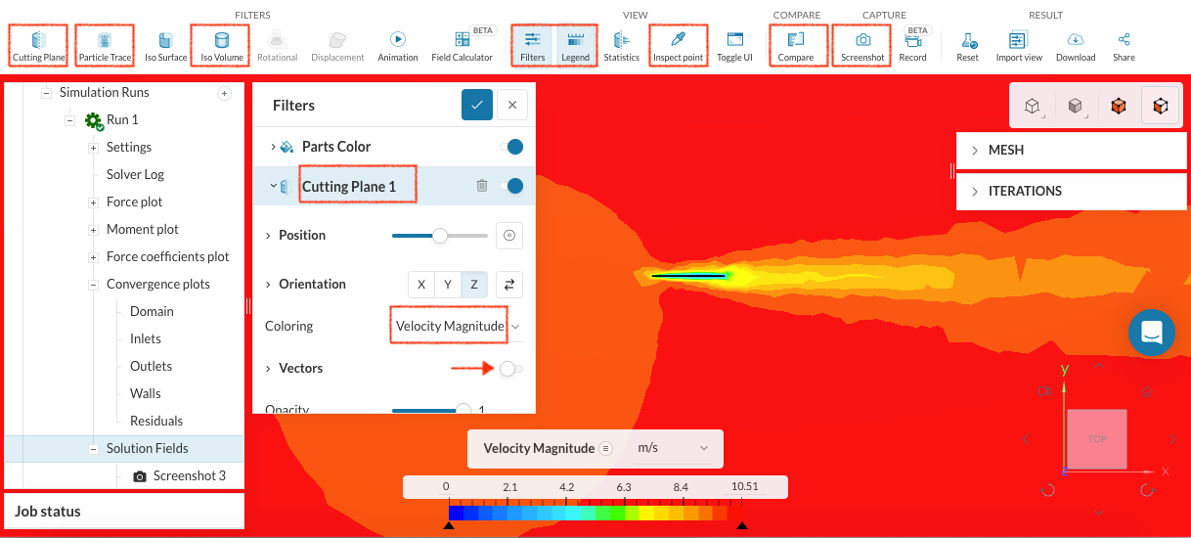
If not, continue by selecting ‘Post-process results.’ See below for all available post-processing options in SimScale:
- Cut Plane: Slice the domain to visualize parameters on the plane.
- Vectors: Plot vector fields to represent quantities like velocity or force.
- Contour Plot: Display scalar field data using contour lines.
- Probe Points: Insert points to extract data at specific locations.
- Particle Trace: Generate streamlines from seed faces to observe flow patterns.
- Iso Surface: Highlight regions with specific scalar values.
- Iso Volume: Highlight regions within a defined scalar value range.
- Rotational View: Inspect rotational regions by creating blade-to-blade views.
- Animation: Create animations of simulation results.
- Field Calculator: Generate new fields using predefined functions and operators.
- Compare: Visualize result fields from two different simulations side by side.
Please refer to the accompanying image to explore the full range of available options for post-processing. These options provide diverse tools for analyzing and visualizing simulation results in SimScale.
Repeat
The following tutorial is NOT designed specifically for any SPECIFIC angle of attack (AOA). For different angles of attack, please ensure the selection of the suitable CAD model and refer to the Finished Project for accurate values of each parameter to be entered.
Click on the respective Student Copy of the Projects to get started with your projects.