Overview
This chapter delves into a critical aspect of aerodynamics: the examination of airflow over a two-dimensional flat plate at different angles of attack. Laminar flow over a flat plate, a fundamental concept in fluid mechanics, serves as a cornerstone for comprehending fluid behavior. This flow type entails a smooth and orderly movement of fluid particles along parallel layers or streamlines, potentially transitioning to turbulent flows depending on the plate’s length.
The primary focus is on comprehending how aerodynamic coefficients evolve with changes in the angle of attack. Notably, it is observed that drag peaks when the flat plate is perpendicular to the incoming flow velocity, while lift achieves maximum efficiency at a specific angle of attack.
Geometry models of the flat plate were created using SolidWorks, followed by simulations conducted through SimScale. Rigorous measures are taken to ensure the accuracy of simulation results. This involves thorough comparisons with theoretical calculations based on the traditional formulas for calculating drag and lift coefficients. Additionally, internal consistency checks are performed by comparing results from different simulation runs, thus bolstering confidence in the outcomes obtained.
ESSENTIAL THEORY
Formation of Boundary Layer
Boundary layers represent the region adjacent to a solid surface where the effects of viscosity are significant.
The flat plate boundary layer , often referred to as the Blasius boundary layer (Re < 500,000), is a fundamental concept in fluid dynamics that describes the formation of viscous fluid layer near the solid smooth surface of a flat plate kept at zero angle of attack. As a fluid flows over the solid surface, friction between the fluid and the surface slows down the flow near the surface, leading to the formation of a boundary layer.
The formation of the boundary layer is primarily due to the effects of viscosity within the fluid. Viscosity is the internal frictional resistance to flow within a fluid. When fluid particles come into contact with a solid surface, the viscous forces between the fluid and the surface cause the fluid particles to adhere to the surface and slow down. Water flows easily and doesn’t stick much to surfaces—it has low viscosity. Honey, on the other hand, is thick and sticky—it has high viscosity.
Velocity Profile for Laminar Flow

Within the boundary layer, the velocity varies from value zero(due to the no- slip condition) on the solid surface and gradually increase to the free stream value at the edge of the boundary layer. The perpendicular distance from the surface to the point where the velocity of the flow is equal to 0.99 times that of the free stream, is called the boundary layer thickness.
The Blasius equation for the boundary layer thickness can be written as:
δ = 5x /√Re
This equation represents the relationship between the boundary layer thickness (δ), the distance along the flat plate surface (x), and the Reynolds number based on x and the free-stream velocity (Rex).
δ∝ √x
δ ∝ 1/√u∞
Reynolds Number and Flow Regimes
The local Reynolds number characterizes flow regimes, increasing linearly downstream. For laminar flow over flat plates, the boundary layer remains laminar until a critical Reynolds number, approximately 500,000, beyond which it transitions to turbulence. Shear stress at the plate is also influenced by the local Reynolds number.
NOTE: This is important when we’re looking at flat plates set at zero angle of attack.
Aerodynamic Coefficients
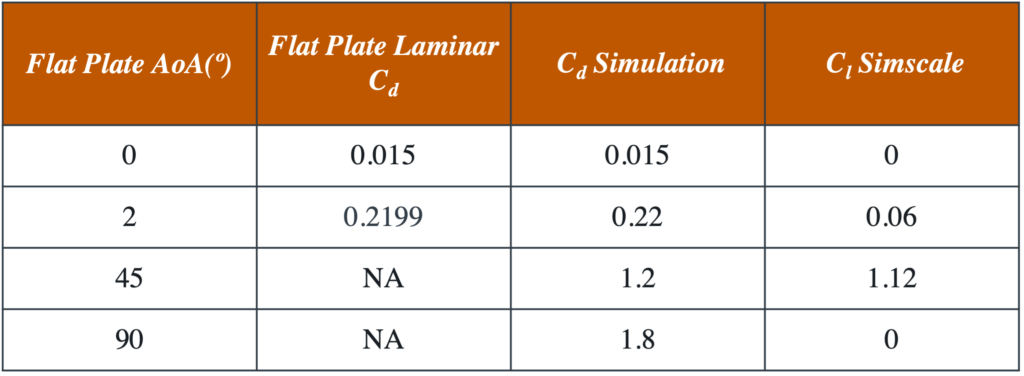
If we take the flat plate, and pitch it up to a small or large angle of attack, we find experimentally that the lift coefficient peaks at around 1.2 when the angle of attack is 45°, then gradually drops to 0 at 90°, when the plate perpendicular to the free-stream.
For drag, when a flat plate is directly facing the airflow (at 90°), its drag coefficient is about 2. The flow is separated at the corners of the plate, and thus a large wake region leading to high coefficient of drag.
Validation Results
REFERENCES
[29] Wright-Patterson Air Force Base, “A New Boundary Layer Conceptual Model for Flow along a Wall,” https://www.researchgate.net/publication/346964614_A_New_Boundary_Layer_Conceptual_Model_for_Flow_Along_a_Wall.